Procedure 01 · Bariatric surgery
Gastric sleeve
Also called sleeve gastrectomy. It's the most performed bariatric procedure in the world: about 80% of the stomach is removed, and what remains takes the shape of a narrow tube.
It doesn't work by size alone. Removing the upper curve of the stomach also cuts production of ghrelin, the hormone that triggers appetite. That's why most patients say they stop feeling constantly hungry — not just that they fill up sooner.
Before
Whole stomachAfter
Gastric sleeveThe dashed outline marks the portion removed: roughly 80% of the stomach, including the fundus, where most ghrelin is produced. Illustrative diagram.
- 60–90 minApproximate surgery time
- 1–2 nightsIn hospital
- 5–7 daysTypical stay in Puerto Vallarta
- 50–70%Excess weight lost at 2 years*
Who operates on you
Before any surgery date exists,
eight specialists review your case.
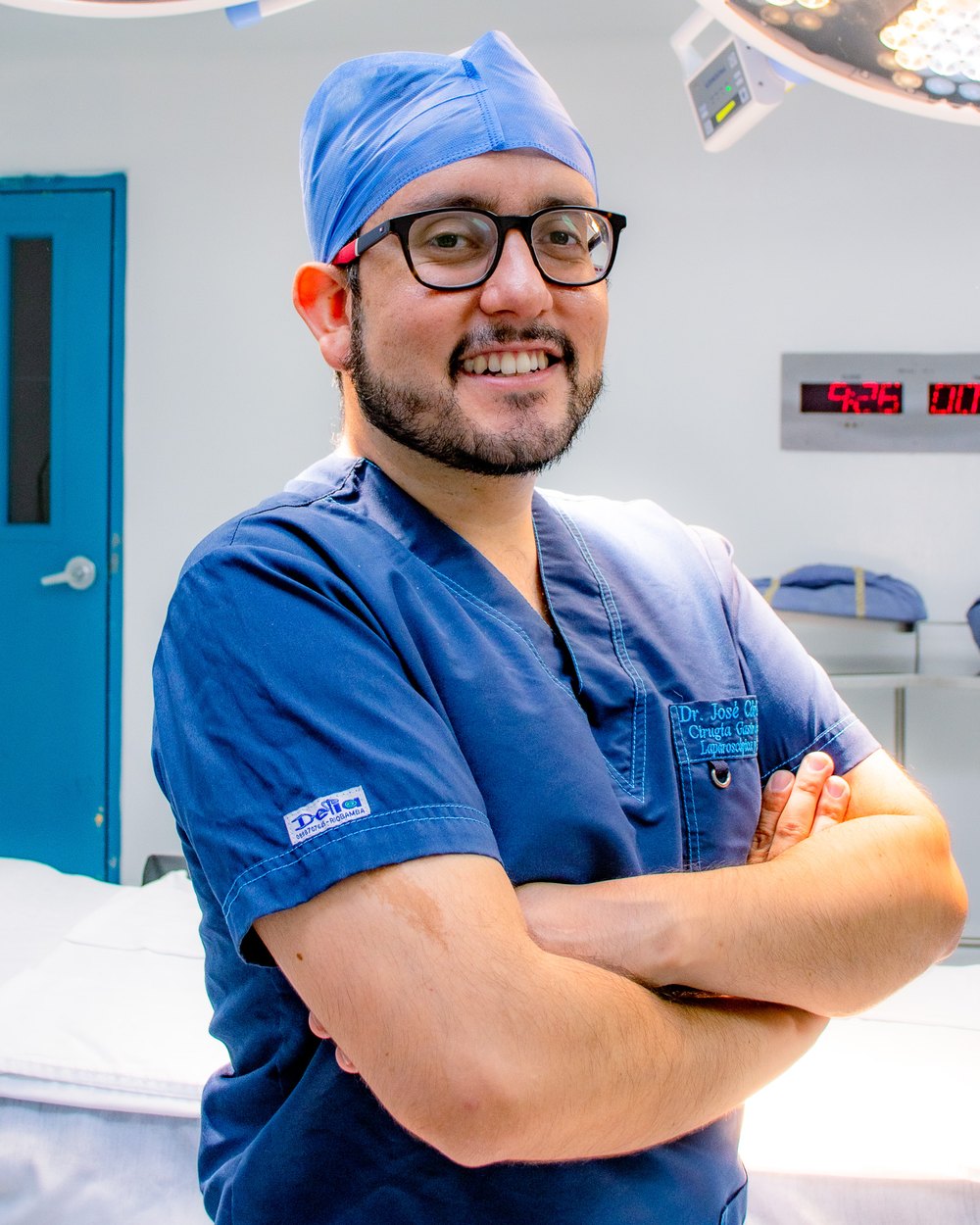
Dr. José Andrés Cárdenas Figueroa · General and bariatric surgeon
Board-certified by the Mexican Board of General Surgery
How it works
Two mechanisms, not one
Less volume
The stomach goes from holding one to one and a half liters to a tube of roughly 100 to 150 milliliters. You feel full with much smaller portions — that's the part everyone knows about.
A hormonal change
The removed portion includes the fundus, where most ghrelin is made. With it gone, the hunger signal from your stomach to your brain drops. That's why a sleeve works better than any restrictive diet: you're not fighting hunger, you have less of it.
It also explains why results hold or fade depending on follow-up. Hormone levels adjust over the months, and that's where nutrition and psychology come in.
What it doesn't do
A sleeve doesn't change how food travels through the intestine, so there's no significant malabsorption. That makes it simpler, with fewer nutritional deficiencies than a bypass — but also less powerful for hard-to-control type 2 diabetes. And it doesn't fix reflux; in some patients it can make it worse.
The procedure
What happens on the day
Done laparoscopically: four or five incisions of less than a centimeter each, without opening the abdomen.
Admission and preparation
You arrive fasting. Tests are confirmed, an IV is placed and blood-clot prevention is given. Final check with the anesthesiologist.
General anesthesia
You're fully asleep, with continuous monitoring throughout.
Laparoscopic access
Small incisions, and the abdomen is gently inflated with CO₂ to create working space. The camera gives a magnified view.
Freeing the stomach
The stomach is released from its attachments and vessels with advanced sealing devices so it can be shaped.
Calibration and division
A calibration tube sets the width of the remaining sleeve. Along that guide, the stomach is divided with a stapler and the excess portion removed.
Leak check and closure
The staple line is tested for leaks before finishing. The incisions are closed and you go to recovery.
Recovery
What to expect, day by day
Everyone progresses differently, but this is the usual course. If something falls outside it, I want to know that same day.
- Day 0
Recovery and first steps
Pain is managed through the IV. Within hours you'll be asked to walk — the single most effective way to prevent blood clots and trapped gas.
- Day 1
Contrast study and first sips
A contrast X-ray confirms passage and rules out a leak. With a normal result, you start sipping water and clear liquids.
- Day 1–2
Discharge
You leave walking, tolerating liquids, on oral pain medication, with written instructions and a direct number for questions.
- First week
Relative rest
Shoulder discomfort from residual CO₂, tiredness and little appetite are normal. Several short walks a day. No lifting.
- Day 5–7
Post-op check and flight
Wound and tolerance review. Once cleared, you fly home.
- Weeks 2–4
Back to normal life
Most people return to desk work within 7 to 14 days. Walking for exercise; nothing high-impact yet.
Eating afterwards
The four stages
Progression is guided by your nutritionist, by video once you're home. Nobody moves to the next stage by calendar — only when the body allows it.
Clear liquids
First days
Water, strained broth, sugar-free teas, in small frequent sips. The goal is hydration.
Full liquids
About weeks 1–2
Protein-containing liquids of light consistency. Supplements begin.
Purées
About weeks 3–4
Smooth textures, protein first at every meal. This is where you learn to eat slowly.
Solids
From week 5–6
Gradual reintroduction, one food at a time, to identify what you tolerate.
Vitamin and mineral supplements are for life and not optional. That's why five nutrition consultations are included in the price: diet is half of the treatment.
Is it right for you
When a sleeve is the option,
and when it isn't
A sleeve is usually right if
- Your BMI is 35 or higher, or 30–35 with a metabolic condition
- You don't have significant reflux or a large hiatal hernia
- You want the least change to your digestive anatomy
- You want a lower risk of nutritional deficiencies than with a bypass
- You take medications whose absorption shouldn't change
Consider another option if
- You have severe reflux or esophagitis — a sleeve can worsen it
- Your type 2 diabetes is hard to control — a bypass usually does more
- Your BMI is very high and the largest possible loss is the goal
- You already have a sleeve and regained weight — that's revision surgery
This decision isn't made by reading a web page. It's made with your endoscopy, your labs and your medical history on the table — which is why the evaluation exists.
What also has to be said
Sleeve-specific risks
A safe procedure in experienced hands and in a proper hospital. Safe doesn't mean risk-free.
Staple-line leak
The most serious specific complication. Uncommon, but it must be caught early — the reason for the contrast study before discharge and close monitoring in the first 48 hours.
New or worse reflux
Some patients develop or worsen reflux after a sleeve. Sometimes it's managed with medication; sometimes it requires conversion to bypass. It's why the pre-op endoscopy isn't optional.
Bleeding and general risks
Staple-line bleeding, wound infection, blood clots and anesthesia risks, reduced by thorough evaluation, prevention and early walking.
Stricture
Narrowing of the sleeve that makes it hard for food to pass. Uncommon, and usually treated by endoscopy.
Nutritional deficiencies
Fewer than with a bypass, but real: iron, vitamin B12 and vitamin D mostly. Prevented with lifelong supplements and labs.
Weight regain
Happens in a share of patients, almost always tied to dropping follow-up.
After discharge, contact us immediately if you have
Fever, abdominal pain that's getting worse instead of better, a racing heart at rest, shortness of breath, persistent vomiting or inability to keep liquids down. If you're already home, go to your local emergency department first, then call us.
For patients who travel
Flying home after surgery
The main concern on a flight after abdominal surgery is a blood clot in the legs. The risk is manageable, and these steps are what manage it:
- → You fly only after you've been cleared at your post-op check.
- → Book an aisle seat and walk the aisle about once an hour.
- → Wear the compression stockings we give you for the whole trip.
- → Keep sipping fluids throughout the flight, in small amounts.
- → Take any blood-thinning medication exactly as prescribed.
If you notice calf pain or swelling in one leg, chest pain or shortness of breath — during the flight or in the days after — seek emergency care immediately where you are.
Cost
What a gastric sleeve costs
Bariatric surgery starts at $6,500 USD, including the hospital stay, the full specialist team and six months of follow-up. Flights and hotel aren't included.
Common questions
About the gastric sleeve
Is the gastric sleeve reversible?
No. The part of the stomach that's removed can't be replaced. It can be converted, though: if severe reflux develops or the result doesn't hold, a sleeve can be turned into a gastric bypass with revision surgery. Decide assuming it's permanent.
How much weight will I lose, and how fast?
Published studies report losses of 50% to 70% of excess body weight in the first two years, with the steepest drop between months 3 and 12. Be wary of anyone who gives you an exact number without evaluating you.
Will I lose hair?
It's common between months 3 and 6 and is usually temporary. It responds to rapid weight loss and to protein and micronutrient intake, and is largely prevented by sticking to your supplements and protein targets.
Will I have loose skin?
It depends on how much weight you lose, your age, your skin's elasticity and how long you carried the extra weight. With large losses it's common. Plastic surgery, if you want it, is considered once weight stabilizes — usually after 12 to 18 months.
Can I get pregnant after a sleeve?
Yes, and fertility often improves. The general recommendation is to wait 12 to 18 months after surgery, until weight stabilizes, with close nutritional monitoring during pregnancy.
How many days do I need to stay in Puerto Vallarta?
Plan on 5 to 7 days: final evaluations, surgery, one to two nights in hospital and a post-op check before your flight. Follow-up afterwards can be by video.
About this page
Written and reviewed by
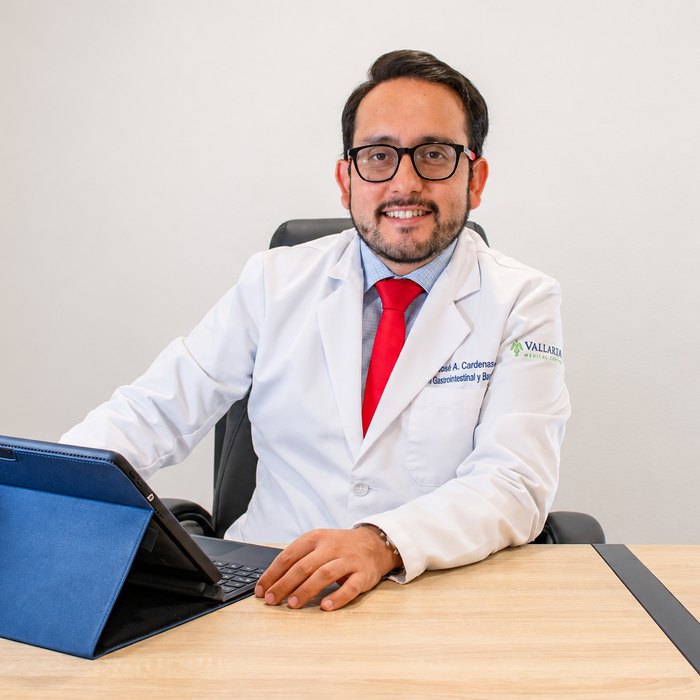
Dr. José Andrés Cárdenas Figueroa
General & bariatric surgeon
Residency in General Surgery at the University of Guadalajara, followed by post-residency high-specialty training in Advanced Minimally Invasive Gastrointestinal Surgery at the Autonomous University of Guadalajara. Staff surgeon at Hospital Vallarta Medical Center and Hospital Punta Mita.
Google reviews
What patients say — unedited
every one of them 5 stars
“Highly recommended. A doctor with a great deal of experience who explains everything in such detail that you get the confidence you need before going into the operating room. Thank you for the empathy, care and monitoring during and after surgery.”
Translated from Spanish · original on Google
“Attentive and dedicated, very professional and punctual. I'm very satisfied with the care and how quickly everything moved, from the first consultation to the procedure and the post-op visits. I highly recommend him!”
Translated from Spanish · original on Google
“Dr. Cárdenas performed laparoscopic surgery on my mother-in-law to remove her gallbladder, which was already badly infected. His prompt care kept it from getting complicated and, thanks to that type of surgery, she recovered quickly. We highly recommend him.”
Translated from Spanish · original on Google
Reviews are shown exactly as patients wrote them on Google, translated from Spanish. We don't write, edit or pay for reviews.
Next step
Is a sleeve right for you?
Let's find out
Tell me about your case in a couple of lines. A consultation doesn't commit you to surgery — it commits you to having real information.
WhatsApp is free and works with U.S. and Canadian numbers. We're on Central Time (UTC−6) year-round.